VIÐTAL – EYJÓLFUR PÁLSSON

[A translation of an article from the Icelandic newspaper Morgunblaðið September 10, 1995]

various people are more clever than i am

Eyjólfur was born in Reykjavík on June 27, 1946. His ancestors lived at Skagaströnd in North Iceland and Hérað in East Iceland.  As a child he lived with his grandfather and grandmother on their farm at Melar in Fljótsdalur valley for ten summers and still today he is very concerned that those bonds do not get worn out. He heads east at least twice a year, in recent years always to take part in rounding up the sheep and sort the in the pen. „We go searching for sheep all the way to Mt. Snæfell. It is tough but is assists you mentally. People have experienced hazardous journeys while searching, but I have been lucky,“ says Eyjólfur.

THE ONLY ICELANDER

Eyjólfur was trained as a cabinetmaker at the Technical School in Reykjavík and after completing his education  he went to Denmark where he attended an entrance examination at the renowned design college Kunsthåndværkerskolen in Copenhagen. He was among 50 applicants attending the examination and the fact that only 12 would make it into the school was not likely to make people more optimistic. But Eyjólfur was one of the 12 students who passed the examination. He completed his studies in 1970.  „It was a time of prosperity in those years and everybody got a job. People had even made sure they would get a good job before they graduated and together with my Danish schoolmate I started to work in an office belonging to an architect by the name Kay Kørbing. That was a nice job, Kørbing was mainly doing designs for cruising ships. I settled there for two years, but then I went home and started working at Gunnar Ingibergsson’s and later with the architects Hrjóbjartur Hrjóbjartsson and Geirharður Þorsteinsson.  I was with them for six years. It was while I was working with them that I founded the firm Epal. You might thus say that I am not one of the oldest workers in the firm although I founded it and I have owned it from the very beginning,“ says Eyjólfur.
SENSE OF LOSS

What was his intention with the founding of the firm Epal and what was it all about?  „They are not many who know that the name Epal is linked to my initials Eyjólfur Pálsson – Epal, it was my relative Helgi H. Jónsson, the journalist, who has the honour of the name. Epal was among the first stores specialising furniture and furnishings. The idea was awfully simple. I thought there was a lack of many of the good and well made  things I had seen abroad, such as curtains, lights, furniture. I merely had a sense of loss and that was why I started importing many of these things. In the very beginning most of it was imported from Denmark. Later on I started working with different domestic designers and I assisted them introducing their work. That means traffic in both directions, as many people contact me and furthermore I try to keep in touch with what is going on concerning design here in Iceland as well as abroad, and if I see something I think would fit or attract attention, I am ready to initiate some co-operation. Some of this has been very successful and I could mention as an example a curtain pattern by Jóna S. Jónsdóttir. It was stamped in four different colour nuances and we sold thousands of meters of it,“ says Eyjólfur. And he is asked to go on:  „Well, different things have been done and some of them cost more than what they returned. And vice versa. I get many ideas. For instance, we co-operated with the textile designer Sigrún Guðmundsdóttir who designed clothes from the different materials I was offering. The purpose was to show that you might use materials for lots of other things than we do traditionally. We also worked with clothes designer Eva Vilhelmsdóttir who designed leather clothes and we arranged an exhibition at Hótel Borg which attrected great attention. Guðrún Margrét and Oddgeir Þórðarson designed a very big sofa that Tolli decorated with paintings. We didn’t sell many of them but they attracted tremendous attention. It would actually be awfully boring to be in this business if I didn’t have this alternate branch to introduce something new and unusual,“ says Eyjólfur.
DESIGN MINDED CO-NATIONALS

How do Icelanders accept your design-linked ideas? „It is easy to say that we have experienced an enormous interest in it and it is obvious that the need for such activity was there to a great extent. I have the experience to confirm that, I have been in this business for a little more than twenty years.“ And  doyou think you and your firm have been a success?  „We have tried many things and we haven’t been consistently successful.  Through the years there have been ups and downs, but generally I think it has been a success and I have been very lucky with staff. I could point out various acknowledgements to confirm this because I am not the only one claiming that Epal does a good job.  Two years ago three of five acknowledgements were ours on a Design day held by Form Island, among other things for a lamp designed by Pálmar Kristmundsson and a sofa designed by Guðrún Margrét and Oddgeir.  I might mention as well that the Danes have noticed what I am doing here up north and in 1986 Epal accepted the acknowledgement „Landsforeningens Dansk arbejdes diplom og Prins Henriks æres medalje „(The diploma of the National Organisation Danish Work and the Prince Henrik medal of honour) which is granted all over the world to those who are considered to be doing well in producing or selling Danish design. Epal was only the third party in Iceland to receive this award.“  But isn’t it difficult to be constantly full of ideas?  „I have never said that I always make the right choice, but it demands a lot of work to keep up with what is going on in design matters here in Iceland and elsewhere. I would even not be against handing over the store to a good partner and devote myself completely to the studies and the design matters. It is in fact very gratifying to assist people to present themselves and their design. But you asked how it was to be constantly full of ideas. Actually not everybody agrees that Epal has been very fertile during recent years; they say that some stagnation has set in. Whether or not this is true I would be the last one to judge, but if this is the rumour it would be absurd not to take it into account. That is why I have decided to change the emphasis quite a lot,“ says Eyjólfur grinning. What does this change of emphasis include?  „I can mention as an example that we are starting to introduce American design in some curtain materials from a Danish manufacturer. There are as well furniture, lamps and upholstery never seen in Iceland before. We have a special presentation of these products throughout September. This line reflects very well what we have always emphasised which is never to offer anything of bad quality. We have never imported anycheap things. The word cheap is however relative because the products that we sell have always been at the same price or even cheaper than in the country of origin,“ says Eyjólfur and he continues: „It is a substantial misunderstanding that a good product would necessarily be expensive and for some reason we have the label on us that we are expensive. I think the explanation is that when the economic situation was more difficult some years ago we did not do what many others did, start to import cheaper products. We never lowered the standard. Those years were difficult but I think we are now  harvesting for the trouble. Now we see some very enthusiastic activity in society and everybody agrees that we offer good products. And many people have verified that our products are not expensive when you take the quality into account. You could say that we are our own enemies offering these quality products, as they last maybe 15 to 18 years, need no recovering, while something of less quality and cheaper would be outworn in 2-3 years.“

OTHERS BETTER

After Epal had been here and there we moved to Faxafen in 1987 and the house was one of the first ones in the area where a great many firms are located today. It was considered a total mistake to establish a store in that remote place in those days. Since then there has been constant construction activity and the area is one of the most fertile commercial centres in the country. The Epal House is designed by architect Manfreð Vilhjálmsson; he received the culture award of the newspaper DV for it. On this occasion Eyjólfur is asked why he did not design the house himself and why he is constantly asking everybody else to design for him as he is a designer himself. And does Eyjólfur design anything after all? „Of course I am a cabinet maker and not an architect. Referring to the other question the answer is that he designs himself. As an example I can mention the year 1992 when I was a member of the executive board of a design exhibition in Perlan. One of my roles was to encourage people to design and take part. I was to act as a good example and design something myself. On the contrary I would like to tell it as it is that various other designers are more clever than I am and therefore there is more need to search for them and introduce them. This search for talent and ideas has always been an important part of my work and you might say that a new dimension entered into my work when I accepted to be a member of the board of an experimental project under the Prime Ministry one and a half year ago. The purpose of the project is to assist cottage industry and small-scale industry around the country. It is mainly manufacture of smaller utensils made of all possible and impossible materials. We are three members of the board and one employee and contact persons all over the country. When we started it was planned that this project should last three years.  We do not have unlimited funds to support people economically, but we assist people in various ways, pointing out optional solutions, etc. Among the things we have done is to arrange a competition in design of small utensils made of Icelandic raw materials. The response has been unbelievable, some 410 proposals from all over the country.  We granted some 19 awards but it was hard to choose, as many outstanding ideas emerged. It is unquestionable that this work has returned a lot already and many things have not surfaced yet. This project has proved to be very gratifying and has strengthened my interest in getting down to consultancy of this type exclusively, “ says Eyjólfur.

THE WORK AND HOBBIES

But besides that, is the work maybe your main hobby or are you into horses, angling, or something else in order to relax?  „You might say that my work is my main hobby. That is to say that my work is linked to my immense pleasure of travelling.  I travel around the world in connection with my work and in that way my work and my hobbies are linked together. I attend exhibitions and conferences and you get to know so many people in this field that inevitably I am invited to come here and there. Thus, for instance, I have become acquainted with Italy over the recent years through an Italian agent from a company I do business with. On such invitation trips it is possible to relax together with my family and do the work as well. In Italy I was invited to stay in a vacation house in the mountains for one week and then for another week in a house on the beach. And Italians pamper their guests and do everything to please them. The newest country on my sights is Japan. I have been there once and I am on my way again to attend an international conference for indoor architects in Nagoya. It will undoubtedly be very interesting as I have received an offer that my wife Margrét Ásgeirsdóttir and I may stay in a Japanese home. The Japanese generally don’t like that but I asked whether it would be possible and it was arranged. That is the way I like to travel, i.e. to get acquainted with the people and their culture as much as possible.

A CASE OF ENTHUSIASM

The journalist is about to end the interview but that is not accepted until Eyjólfur has mentioned his enthusiastic case which he has not mentioned until now. Eyjólfur has the final words: „For a long time I have been considering, and I am very enthusiastic about this, that everybody concerned with design matters, in whatever way, should unite and incite the discipline og raise more dignity and respect for it. There a various organisations all over but nothing happens. I have discussed this with different people in various branches and I have received positive responses. It might be a slight exaggeration to claim that there are indications of a strong movement, but nevertheless people are discussing the matter and that is the start of something more. I can feel that such unification is at hand and then it will be more fun doing this.“

CIVILIZING DESIGN – AÐALSTEINN INGÓLFSSON


CIVILIZING DESIGN:

EPAL DURING A QUARTER OF A CENTURY

I would like to start by confessing that twenty five years ago I didn’t consider Eyjólfur Pálsson capable of great ventures, not as a design pioneer nor as a businessman. His appearance, chin-tufted as he was, and speaking so silently that one would say „Pardon me“ every time he said something, looking somewhat dreamingly over his sisal-mats, the PH-lamps and the Børge Mogensen furniture in the store in Síðumúli, he reminded you of a flower child of Danish family who had wandered into business.

It wasn’t until I tried to negotiate with Eyjólfur on favourable instalments on furniture  I was buying from him that I realized that in this peaceable gentleman rested a hard-nosed businessman. Moreover, I could have told yourself, that whoever called his company so directly after himself, must be very  self-confident.

Eventually, people realized that Eyjólfur’s „dreams“  were feasible. It was possible to sell fine design to Icelanders, furniture and other equipment, although these things were more expensive than simple mass production. This salesmanship has, however, probably demanded enormous work and farsightedness. Nevertheless, the manager remained calm.

On second thought, apparently, the founding of EPAL was part of a bigger design wave abroad. The late seventies and the first part of the eighties were  times of extreme prosperity, people had enormous amounts of money and were very eager to buy specially- designed things, new and old. Designers, design companies and stores blossomed as never before. Also during this period, special design museums came into being, the Design Museum of London, the Wolfsonian Foundation of Florida an the Frank Lloyd Wright Museum in Michigan.

When the last economic crisis occurred less than a decade ago, it of course affected badly these very design companies, designers and museums. I am not very familiar with the internal affairs of Eyjólfur’s company, so I am not well aware of how he managed to keep the company afloat through those difficulties and make it the super power in design development it is today. I think that this success is not least due to a sensible purchase policy. Instead of sticking tightly to international luxury design, especially various very expensive eyecatchers from Italy, Eyjólfur chose to cultivate contacts with the Nordic countries above all.

There the roots of modern Icelandic design are to be found, and also the roots of numerous educated Icelanders; moreover, different aspects in the way of thinking among Nordic designers affects us directly in Iceland. All of this should have made it easier for Eyjólfur to sell remarkable quantities of Nordic furnishings to companies and schools and thus strengthen EPAL’s economic base.

Eyjólfur was doing business, no doubt about that. But none of his customers could fail to notice that good design was his passion. In the name of this passion he was prepared to take various risks:  to establish co-operation with designers like Ole Kortzau, to cost the design of prototypes, to support young Icelandic designers in producing and marketing their products, and even to start the production of specially- designed products under EPAL’s. Some of these risky projects worked out, others didn’t. The point was that no one else, not even the State itself, with its numerous development funds, seemed to be interested in costing such development work. For Eyjólfurs great courage, the Danish export industry presented him with a fine bicycle; more over his majesty the Danish Prince Henrik awarded him a medal and a diploma. Up to now, the Icelandic authorities have not offered him any such loyalty.

In order to keep up with various innovations in Nordic furniture design, interested people only needed to drop by EPAL regularly, at first in Síðumúli and later on in the graceful building designed for the company by Manfreð Vilhjálmsson in Skeifan. There the director wasseen walking about, somewhat absent-mindedly, maybe pointing out a new sofa, upholstery or lamp equipment, mentioning the advantages and the disadvantages of the article in question in very few words. I think that the term „nice“ might have been the strongest praise about design he would express. But then again the thing would be really excellent. And I suspect, that these brusque comments by Eyjólfur made some people scrutinize design in a new way; wonder what makes a well-designed utility desirable.

It wasn’t until one participated in meetings with Eyjólfur that one would understand why he was always so absent-minded. This man is located totally in the future, ceaselessly deliberating something, not only for his own company, but also for design in Iceland. exhibitions, conferences, presentations, marketing campaigns, construction projects and various co-operative projects with designers. Each meeting with him turns into brainstorming – however softly, which benefitted the undersigned when he launched the design prize hosted by the newspaper DV. Usually the most useful comments and the best ideas came from Eyjólfur.

At the begining of a new century there has been some turbulence within the area of design, as well as within other areas of the visual arts. Exhibitions of young designers’ work carry with them that the tasteful modernistic design that Icelanders have inherited from the Nordic pioneers is now in trouble. The younger generation seems to prefer systematic chaos instead of systematic tastefulness. What will then become of a company like EPAL? I am really hoping that the mission of civilizing design will be carried on, design that makes it easier for us to enjoy our lifes to the fullest, in agreement with the environment in which we live. And the one who can really spread that gospel in this country is Eyjólfur of EPAL.

Posted in Óflokkað

CRAZY ART – FROM UNDIRTÓNAR

The Icelandic culture has spread widely and now most recently in the store Epal

Við drógum línur í jörðina
drógum línur í eldinn
línur í loftið
og vatnið
við tyllum á þær ýmsu eldfimu
ýmsu laufléttu
vatnsheldu
eða var það sandfimu og eldlétta?
var það laufheldu og vatnsblásnu?

                                   SJÓN 

The furniture store Epal, situated in Skeifan 6, arranged an interesting exhibition on Thursday 22 March. The store seeks different paths compared to other furniture stores, according to Fridrik Weisshampel, who is presentation and marketing manager at Epal. There you can find furniture which you will not see in any other furniture store. You will find a lamp which blows itself up when you light it, furniture on the move og other similar fantastic things. Eyjólfur Pálsson, owner of Epal, was in charge of the arrangement, and he was also in charge of the exhibition “Tilfelli” (Incidents) in the old Sputnik house at Hverfisgata last October, which was arranged by the sisters Bára Hólmgeirsdóttir and Hrafnhildur Hólmgeirsdóttir.

The arrangement on 22. March was entitled “Fjörfiskur”and it is an installation or a happening. It was produced by many professionals, the artistic director was Finnur Arnar, music by Jóhann Johannsson and light design by Kjartan Thorisson. Professional consultance provided by Ágústa Gudmarsdóttir and Valgerdur Melsted designed the costumes. Ólöf Jakobína Ernudóttir was stylist and last but not least, the poet Sjón gave the happening a poem. The performance started when the happening group took down cards from a wall, one by one, each with a letter and arranged into the ceiling so you could finally read the nice poem. Meanwhile the music of Jóhann Jóhannsson, a member of the organquartet Apparat sounded, which was one of the nicest things of the evening, surrealistic pop music.

This evening was very succesful and hopefully other furniture stores will copy this excellent idea.

From Undirtónar.

Posted in Óflokkað

Nýjungar frá Joseph Joseph

Bráðsniðuga og flotta hönnunarfyrirtækið Joseph Joseph hefur nýlega sent frá sér ýmsar nýjungar sem eru þó í takt við eldri vörurnar, einstaklega smart, sniðugar og stílhreinar.

Cut & collect er sniðugt skurðarbretti með skúffu.

Cookbook bókastandur er sniðugur til að halda matreiðslubókinni opinni eða undir i-padinn á meðan eldað er, en bókastandinn er síðan auðvelt að geyma í bókahillunni á meðan hann er ekki í notkun.

Cooking gift set, er hugsað sem gjöf og kemur í smekklegri gjafaöskju sem inniheldur þrjár sívinsælar vörur í eldhúsið.

Sívinsælu og margverðlaunuðu litaskiptu skurðabrettin frá Joseph Joseph eru núna til með stállituðum merkingum fyrir ennþá stílhreinna útlit.

Mjög hressandi nýjung eru Kitchen beats, kassettu og plötu vinnubretti úr hertu gleri, tilvalin tækifærisgjöf fyrir tónlistarunnenda.

Hér má sjá brot af nýju vörunum frá Joseph Joseph en í Epal er mjög gott úrval af bráðsniðugum og smart vörum frá þeim.


Og ekki gleyma að koma við og skoða sýningu til heiðurs Arne Jacobsen sem hönnuð er af arkitektinum Micheal Sheridan fyrir Fritz Hansen.

Arne Jacobsen & Fritz Hansen

Nú stendur yfir í Epal sérstök sýning til heiðurs Arne Jacobsen sem hönnuð er af arkitektinum Micheal Sheridan fyrir Fritz Hansen.

Arne Jacobsen (1902-1971) er þekktur sem áhrifaríkasti arkitekt sem uppi hefur verið. Meistaraverk hans sem arkitekt eru meðal annars SAS hótelið í Kaupmannahöfn ásamt St Catherine skólanum í London.

Arne Jacobsen var arkitekt sem leit á húsið og búnað þess sem eina listræna heild. Hann sá oft bæði um hönnun byggingar, til þess að hanna húsgögnin ásamt öllum innréttingum og útbúnaði.

Sum af hans þekktustu húsgögnum má nefna að sé Eggið og Svanurinn sem hannaðir voru fyrir SAS Royal hótelið í Kaupmannahöfn árið 1957 og eru í dag álitin sem táknmynd skandinavískar hönnunar.

Arne Jacobsen er talinn hafa verið mikill fullkomnisti og afar háar væntingar hans til framleiðslufyrirtækja á húsgögnum sínum leiddi hann á fund með Fritz Hansen árið 1934. Sá fundur markaði upphaf af löngu og afar farsælu samstarfi, en enn þann dag í dag sér Fritz Hansen um að framleiða upphaflega hönnun Arne Jacobsen.


Ýmislegt fallegt frá HAY


Woody er flott eikarhilla frá HAY sem kemur jafn vel út sem frístandandi eða uppvið vegg þar ssem ekkert fram né aftur er gefið til kynna. Allar samsetningar eru sjáanlegar sem gefur hillunni mikinn karakter og hægt er að fá hana með hvítum, gráum eða marglitum hillum sem liggja lausar ofan á viðarrammanum.

DLM (don’t leave me) eru æðisleg hliðarborð sem koma í nokkrum hressandi litum. Borðið er hugsað sem færanlegt kaffiborð og er því með haldfangi svo auðvelt er að kippa því með útá svalir með kaffi og góða bók!

Loop fatahengin eru flott frístandandi fatahengi sem henta vel í andyrið eða undir uppáhaldsflíkurnar í svefnherberginu.

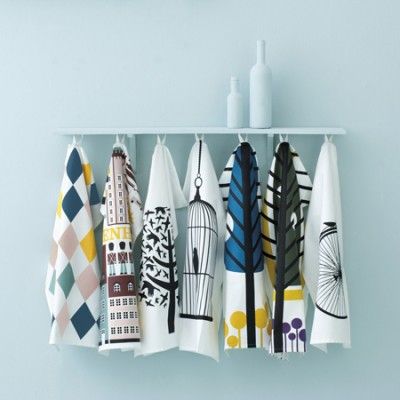
Einnig hefur HAY ásamt Scholten og Baijings hannað í samstarfi æðislegar vefnaðarvörur og þar má nefna þessi fallegu viskustykki hér að ofan ásamt sængurfötum.

HAY er allavega í uppáhaldi hjá okkur!

Útihúsgögn frá Caneline

Caneline framleiðir hágæða viðhaldsfrí útihúsgögn sem þola vel veður, vind og frost. Caneline hefur hlotið fjöldann allann af verðlaunum í flokki útihúsgagna fyrir gæði og fallega hönnun.

Vörurnar eru hannaðar með skandinavíska sumardaga í huga þar sem að útihúsgögnin fullkomna stemminguna. Hönnuðir Caneline hafa haft það að leiðarljósi að láta aldrei útlit víkja fyrir notagildi, og eru húsgögnin því bæði flott og mjög þægileg.


HUGMYNDIR AÐ FERMINGARGJÖFUM

Hér að neðan má sjá ýmsar hugmyndir af skemmtilegum fermingargjöfum,
Flott trédýr og vélmenni frá Areaware
Acapulco stóllinn frá OK design
Fallegar smáhlutahirslur frá Ferm Living
Töff fatahengi fyrir uppáhaldsflíkurnar frá HAY
Sauðabindi fyrir töffara
Smáhlutahirslur frá Iittala, til í ýmsum litum
Gott úrval af klukkum frá Next Time
Flott gæða rúmföt frá HAY
Zuny leðurdýrin er hægt að nýta á ýmsa vegu, flott sem bókastoð
Apinn frá Kaj Bojesen er klassísk gjöf
Master stóllinn frá Philippe Starck kemur í nokkrum litum og er skemmtileg blanda af nokkrum frægustu stólum heims.

HÖNNUNARMARS Í EPAL: GUÐRÚN VALDIMARSDÓTTIR

Keilir og Gígur eru tvenns konar kertastjakar hannaðir af Guðrúnu Valdimarsdóttir, Keilir fyrir há kerti og Gígur fyrir sprittkerti. Þeir eru framleiddir úr mahóný-við og hluti af þeim málaður. Í boði eru þrjár mismunandi stærðir af hvorri útgáfunni fyrir sig og nokkrir mismunandi litir. Fólk getur blandað saman mismunandi stærðum, gerðum og litum og „hannað“ sína samsetningu sjálft.

Nöfn stjakanna vísa lauslega til útlits þeirra og tengjast um leið íslenskri náttúru.

Posted in Óflokkað

HÖNNUNARMARS Í EPAL : MARÚN

Hönnunarteymið Marún sýnir nýja hlið á íslenska þjóðbúninginn.

Hönnuð voru tréleikföng sem stuðla að þroska barna með því að örva samhæfingu augna og handa á unga aldri. Með aldrinum sjá börnin hvernig hægt er að púsla leikföngunum saman á réttann hátt svo að úr verði strákur og stelpa klædd íslenska þjóðbúningnum.

Þau hafa bæði skemmtana- og notagildi en eru umfram allt fallegir hönnunargripir.

Posted in Óflokkað